- Regal Resilience
- Posts
- What the Vikings knew about your voice
What the Vikings knew about your voice
They called her the Völva. She was the most powerful person in the room

Tanyette Colon
March 27, 2026
THE REGAL EDIT
👑 HELLO, REGAL ONES
Welcome to The Regal Edit, your curated digest for living and leading in full alignment. Each edition distills five essentials in business, health, spirituality, lifestyle, and social impact — designed to elevate how you think, feel, and move through the world.
The Regal Edit | The Age of the Storyteller
Before there were books, before there were algorithms, before there were timelines to scroll and feeds to curate - there were stories.
During the early years of the Viking era, no poetry or sagas were written down. Stories lived in the breath of those who carried them passed from voice to voice, fire to fire, generation to generation. The men who held those stories were called Skalds. Their entire purpose was to keep the thread of human experience alive.
I've been thinking a lot about that.
Because here's what I know to be true: we are living in the Age of the Storyteller and most of us don't even realize the power we're holding.
I spent years convincing myself that staying small was somehow noble. That the back of the room was the humble place to be. My voice would literally quiver when I spoke up in a meeting. I had a seven-figure book of business, I was in the top 10 percent in my company, and yet I had somehow mastered the art of hiding in plain sight.
What changed? I stopped running from my story and started owning it.
Your story is not just a collection of memories. It is a repository — every triumph, every loss, every pivot and plot twist it's all blueprint material. And when you stop waiting for permission to tell it, something extraordinary happens: other people start to find their voice too.
That is the ripple effect of an emboldened life.
This week, we're talking about what it means to step fully into your role as the narrator of your own journey and why the world needs your story, exactly as it is.
Because someone out there is waiting for the Skald who sounds like you.
Let's get into it. 👑
Business
The Robots Can Write the Code. Only Humans Can Make You Care.

Let me tell you something that should stop every woman in this community in her tracks.
The most powerful AI company in the world — the one building technology that is reshaping civilization as we know it — is not just hiring coders. They're hiring people who studied literature.
Daniela Amodei, co-founder and president of Anthropic, the company behind Claude AI, majored in literature at UC Santa Cruz. Not computer science. Not engineering. Literature. And she recently told ABC News something that I think every one of us needs to hear right now: "The things that make us human will become much more important instead of much less important."
She went further. When Anthropic looks to hire today, they look for people who are great communicators, who have excellent emotional intelligence and people skills, who are kind and compassionate and curious and want to help others.
Read that again. That is the hiring criteria at one of the most valuable AI companies on the planet.
And the market is following. Anthropic tripled its communications team to 80 people last year and keeps hiring at $200,000-plus per position. OpenAI is offering communications roles north of $400,000 while software engineering job postings have collapsed. According to LinkedIn, the number of job listings that include "storyteller" doubled in 2025.
Here is the plot twist nobody saw coming: AI was supposed to replace writers first… all those articles and emails and marketing copy that seemed so easy to automate. Instead, AI affected coding jobs and made human writers more valuable than ever.
Why? Because large language models can't actually think they generate content without any creative process. They produce words without understanding what those words mean. A 2025 Columbia Business School study confirmed it. The machine can generate. It cannot mean something.
Daniela Amodei put it plainly: "I actually think studying the humanities is going to be more important than ever. A lot of these models are actually very good at STEM. But the things that make us uniquely human, understanding ourselves, understanding history, understanding what makes us tick, will always be really, really important."
This is why we talk about storytelling the way we do at Regal Resilience. It was never just a "soft skill." It was always the skill. The one wired deepest into who we are as humans — the Skalds knew it, and now Silicon Valley is finally catching up.
Your voice is not a nice-to-have. In 2026, it is a competitive advantage.
Own it. 👑
Health
Every Place Has a Story. Some Places Make You Remember Yours.
On travel, solitude, and the artist sleeping inside all of us.
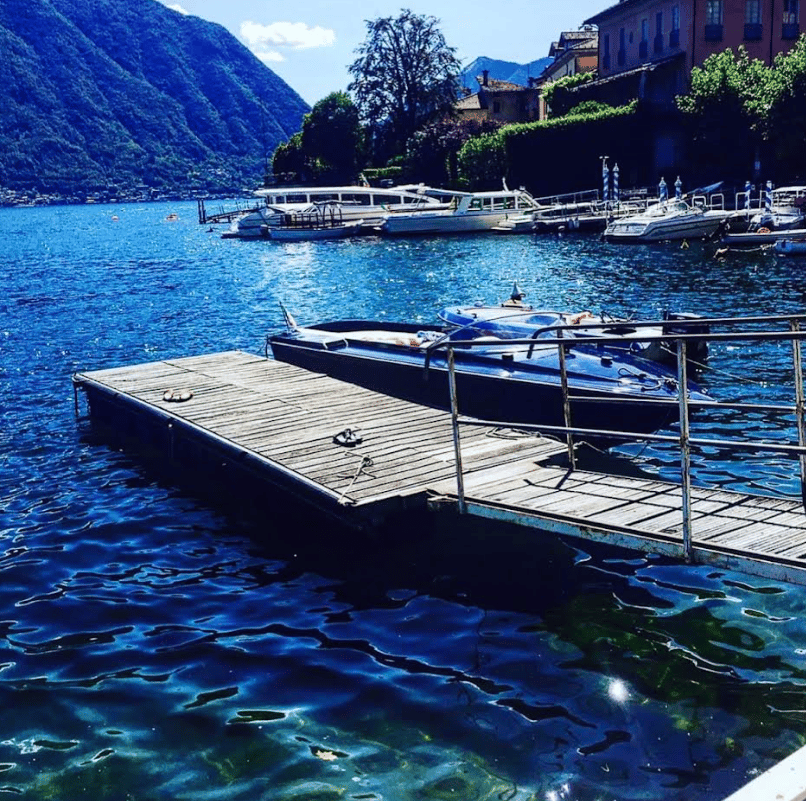
There is a place on the shores of Lake Como where time moves differently. Where the light off the water softens something in you, some urgency, some noise and what remains is quieter and truer than what you arrived with. I have been there. It is one of my happy places. Not because it is beautiful, though it is extraordinarily beautiful. But because something about standing at that shore makes me feel like myself again. Like the version of me who has things to say, things to create, stories still waiting to be told.
I have felt this in other places too. In Norway, twenty-five minutes up a mountain from Oslo, I spent two nights alone in a farmer's cabin that dated back to 1850. No agenda. No performance. Just the silence of black timber walls, a brass-latched window framing more than tree and city framing something that felt like soul and future. I came down from that mountain different than I went up. I had written. I had dreamed. I had remembered what it felt like to hear my own thoughts clearly.
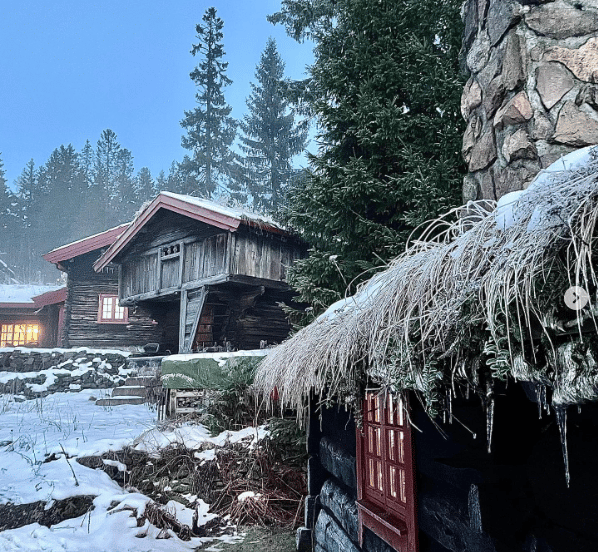
This is what travel does when we let it. Not the travel of checked itineraries and curated photo moments but the travel of genuine arrival. Of showing up to a place and allowing it to show you something back.
What Science Knows About Place and Creativity
The relationship between travel and the awakening of the creative self isn't just poetic. It's neurological.
Clinical neuropsychologist Paul Nussbaum of the University of Pittsburgh describes travel as "dropping your brain into a place that's novel and complex. You're stunned a little bit, and your brain reacts by being engaged, and you begin to process on a deep level." In other words, the very disorientation of arriving somewhere new — the unfamiliar smell, the different quality of light, the architecture that tells you a different story about how people have chosen to live — is precisely what wakes the brain up.
Studies on neuroplasticity show that even brief periods of novel, immersive experience can change brain structure in adults. Every unfamiliar street, scent, and social cue floods your brain with dopamine, the chemical tied to reward, motivation, and learning forming new neural connections and literally rewiring you for greater flexibility and creativity.
And then there is what nature specifically does. In a landmark study, backpackers who spent four days in nature performed 50 percent better on creative thinking tests upon their return. Researchers found that in natural environments, the prefrontal cortex — the part of the brain associated with analytical focus — quiets down, allowing the brain's default mode network to activate. Think of this as the imagination network: the place where insight, memory, and new ideas surface when we stop forcing them to.
In that Norwegian cabin on the mountain, something very specific was happening in my brain. Research published in ScienceDirect found that time in natural environments creates gentle shifts between outward-focused soft fascination and inward-focused mind wandering and that this rhythm is one of the most powerful pathways to creative breakthroughs, new associations of ideas, and the kind of flexible thinking that daily routine actively suppresses.
I didn't need a study to tell me. I felt it. But it's meaningful to know: the dreams I dreamed on that mountain, the plans I made, the words I wrote weren't accidental. The place made them possible.
Architecture as Invitation
There is something specific about the built world about the places humans have designed and lived in that speaks to the storyteller in us before we even reach for a pen.
Walk through the limestone villages of the Italian Lakes. Stand inside a cathedral in Seville where the arches reach toward something. Move through the narrow medina alleys of Marrakech where every surface is handcrafted, where every tile is a small act of devotion. These spaces don't just contain history, they perform it. They ask you to ask questions. Who built this? What did they believe? What did they love? What were they afraid of?
And in asking those questions about them, we begin to ask them about ourselves.
Neuroimaging research shows that cultural immersion enhances activity in the brain regions responsible for empathy, the anterior insula and the medial prefrontal cortex. When we truly inhabit a place, we don't just observe other ways of living. We feel them. And feeling them expands what we are capable of imagining.
This is why writers and artists have always been travelers. Hemingway in Cuba. Gauguin in Tahiti. James Baldwin in Paris. They were not running away from their work. They were running toward conditions that made the work possible.
Solitude as the Other Half of the Journey
But here is what I have learned from my own wandering: the destination is only half of it. The other half is what you do once you arrive.
Science has shown that solitude activates the brain's Default Mode Network, the same imagination network that nature unlocks. When we disengage from the social world and allow ourselves to simply be, memory improves, creativity flourishes, and we develop a clearer, more honest understanding of our own emotions.
Two nights alone in that Norwegian cabin. No noise. No performance. No one to be for. Just the mountain, the window, and whatever needed to surface.
In the blessing I wrote for that little house before I left, I found myself writing: May the low doorways inspire all toward humility — bowing to enter and bowing to exit. May all guests leave and gain a part of themselves — as they dwell within and venture out.
That is, I think, the truest thing I have ever written about travel. The best journeys are the ones where you leave something behind the noise, the urgency, the performance and gain something back. The thread of yourself you had misplaced somewhere between deadlines and obligations and the relentless forward motion of a life lived mostly on autopilot.
A Practice, Not Just a Destination
You don't have to fly to Lake Como or climb a Norwegian mountain to access this. Though I highly recommend both.
The principle is portable. A new neighborhood. A solo afternoon in a museum. A morning at a table by a window in a café where no one knows your name. Any place that interrupts the familiar enough to let the unfamiliar in.
The inner artist and the inner storyteller don't disappear. They just go quiet when life gets loud. Travel ..real travel, intentional travel, travel where you allow yourself to arrive fully turns the volume back up.
Go somewhere that asks something of you. Be still enough to hear what it says. Then write it down.
That is the whole practice.
Lifestyle
The Ritual Has Always Been There. The World Is Just Now Catching Up.
I live in Drammen, Norway part-time, a city nestled between the river and the fjord. There are floating saunas bobbing on the water. The hilltop restaurant tucked away with a yurt, hung with drying sage and wild herbs. The rhythm of heat and cold, sweat and stillness, that people here have practiced for centuries without calling it a wellness trend.
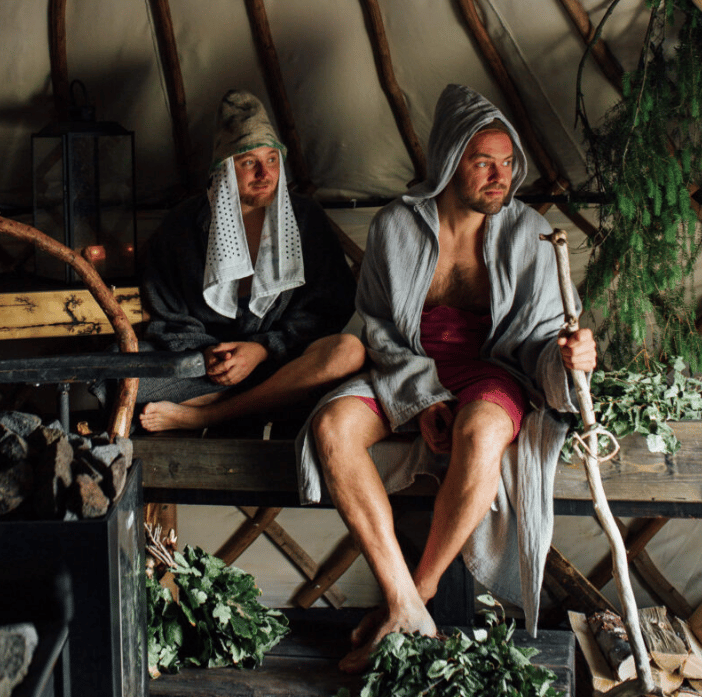
But the world has caught up. And it has a name now: Viking Wellness.
Viking wellness taps into a centuries-old tradition from Scandinavia where heat and cold are not just sensations but a way to reset the body and calm the mind. And in 2026, Condé Nast Traveler named it one of the hottest travel trends of the year. The thing that my neighbors have been doing quietly on the riverbank for generations is now being sought by travelers flying in from around the world.
Here is the protocol and it is beautifully simple. Heat first: spend 10 to 15 minutes in a sauna to raise your core temperature and induce a deep sweat. Cold next: immerse yourself in a cold plunge for one to three minutes to trigger the body's natural reset response. Then rest and rehydrate allow your heart rate to normalize before doing it again. Repeat three times, and the body enters a state of profound restoration.
That's it. No app. No subscription. No optimization hack. Just fire, water, and breath — the way humans have always healed themselves.
This trend is accelerating because people want wellness that feels embodied, elemental, and culturally rooted rather than generic and commodified. It aligns with a broader shift toward nature-based recovery, ancestral practices, and resilience-oriented lifestyles. In a world of digital overload and curated everything, people are hungry for something ancient. Something that makes them feel, in the truest sense, alive.
The places leading this movement:
On Sweden's Gotland island, Sibbjäns a former horse farm transformed into a regenerative farmstay, invites guests to sleep in handcrafted suites, eat hyper-seasonal farm-to-table meals, and take part in Viking wellness rituals rooted in local traditions. Opening officially on April 2, 2026 for its first full season, the property follows Gotland's natural calendar — closing entirely in winter so the land can rest. This is the if-you-know-you-know Nordic escape of the moment.
Closer to home for me, right here in Drammen is Ælvebadstua which sits right on the river with views that will genuinely stop your breath, and Drammen Flytesenter pairs float tanks with cold plunge and sauna in the heart of town. A 45-minute drive south, Son Spa offers Aufguss sauna rituals on floating platforms with fjord views that feel like a painting. And for the bucket-list seekers among you, the Nusfjord Arctic Wellness in the Lofoten Islands offers a sauna followed by a wild seaweed treatment harvested that morning, ending with a plunge into the Arctic Sea.
You don't need to fly to Scandinavia to feel the shift though. Urban wellness studios in major U.S. cities now combine saunas with cold plunge pools, making it easier than ever to access thermal contrast therapy without sacrificing convenience. The ritual is available. The question is whether you'll give yourself permission to slow down long enough to receive it.
This is what has always lived at the heart of Regal Resilience. Not hustle wellness. Not optimize-yourself wellness. The kind of restoration that has been practiced by strong, grounded, purposeful women for centuries on the banks of fjords, in cedar saunas, under open skies.
The ritual was always there. You just needed someone to remind you it belonged to you too. 👑
Social Impact
The Fridge on the Corner That Changed Everything
Here is a number that should stop you cold.
In 2022, households across every continent wasted over one billion meals a day — while 783 million people were affected by hunger and a third of humanity faced food insecurity. One billion meals. A day. Not a year. A day.
According to the UNEP Food Waste Index Report 2024, one-fifth of all food produced for human consumption is lost or wasted globally and the total cost of that loss to the global economy is estimated at roughly one trillion dollars.
We don't have a food production problem. We have a food distribution problem. And two communities in Europe quietly decided they were done waiting for governments to solve it.
In Poland, they built food walls.
Known locally as jadłodzielnie — loosely translated as "food sharing points" — these are places where anyone can leave food they cannot consume, or take what others have left behind. Each point has volunteers who manage them. The goal is to reduce everyday food waste, and they are open to anyone, regardless of wealth or circumstance.

In Warsaw alone, some food sharing points are open 24 hours a day. In just one week, the Foodsharing Warszawa group reported rescuing food over 180 times preventing over 615 kilograms from going to waste.The movement has spread to universities, housing estates, neighborhood squares, and church entrances. It operates on Facebook groups, volunteer coordination, and the profound belief that surplus food belongs to the community, not the landfill.
The need is real. The Poverty Watch 2024 report reveals that one in every fifteen Poles lives in extreme poverty, with 2.5 million people living below the subsistence minimum. The jadłodzielnia doesn't ask who you are or why you're there. It just opens its door.
In Spain, they put a fridge on the sidewalk.
In the Spanish town of Galdakao, Alvaro Saiz was inspired to act after seeing footage of his country's poor — their situations worsened by economic crisis — having to dumpster dive for food. His answer was disarmingly simple: on April 29, 2015, the first Solidarity Fridge was installed in Galdakao. In just one month of pilot testing, the project saved 200 kilograms of food that would otherwise have ended up in a landfill.
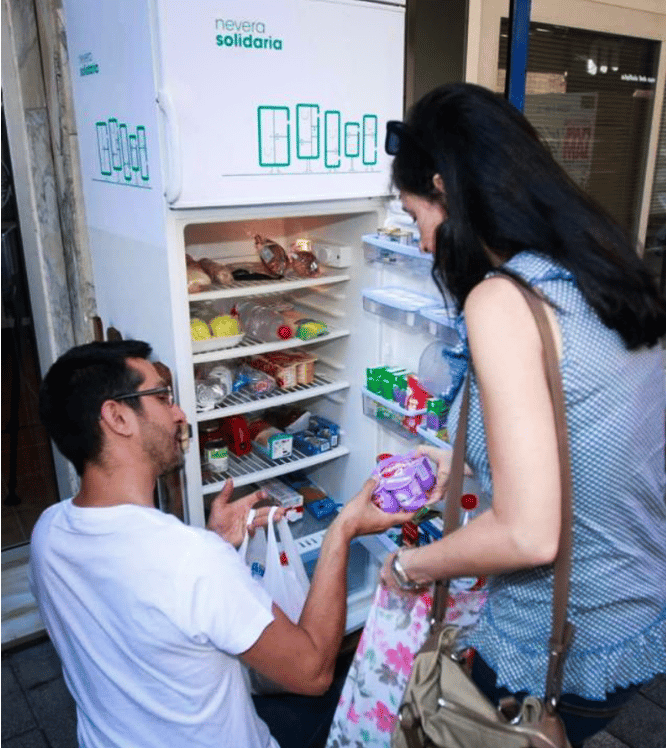
The Nevera Solidaria operates on a principle of radical universality aimed at all people, regardless of their socioeconomic situation. There is nothing more exclusive than doing something only for the excluded, so it is open to everyone. Restaurants, neighbors, bakeries anyone can contribute. Anyone can take. No paperwork. No shame. No questions.
The model has since spread across Spain and inspired solidarity fridge movements in France, Germany, Brazil, Italy, the Netherlands, and the United States.
What strikes me most about both of these movements is not the logistics. It’s the philosophy. They are built on trust. The assumption that people are fundamentally decent, that community is a verb not a noun, and that the act of leaving something for a stranger without knowing who they are or watching them take it is one of the most quietly revolutionary things a human being can do.
In a world obsessed with optimization and ROI, a fridge on a street corner that operates on pure human goodness is, frankly, radical.
And it is working.
Spirituality
She Always Knew. The Völva, the Shield Maiden & the Power They Tried to Bury
Before we called it intuition, the Norse called it seiðr.
And the women who wielded it were called Völvas and the world quite literally came to them.
The Völva was not just an oracle. She was a healer, an advisor, and a spiritual guide. Her wisdom was sought by everyone from farmers to kings.The word völva itself derives from the Old Norse meaning "wand carrier" — a traveling sorceress and seeress who was well paid for her services. She didn't hide her power. She carried it — staff in hand — and was received with reverence wherever she went.

In the Saga of Erik the Red, we meet a völva named Thorbjørg who traveled from farm to farm during a brutal Greenland winter, telling fortunes. When she arrived at a wealthy farmer's estate, a high seat decorated with beautiful carvings was erected in her honor, and soft cushions were placed beneath her. She wasn't tolerated. She was honored.

In an era of hypermasculinity, these women held important and authoritative power in Viking societies. The practice of seiðr encompassing divination, prophecy, healing spells, and shamanic practices was seen as an almost exclusively female domain. In a world that history has long painted as belonging only to men with swords, the most spiritually powerful seat in the room belonged to a woman.
And then there is the discovery that stopped archaeologists cold.
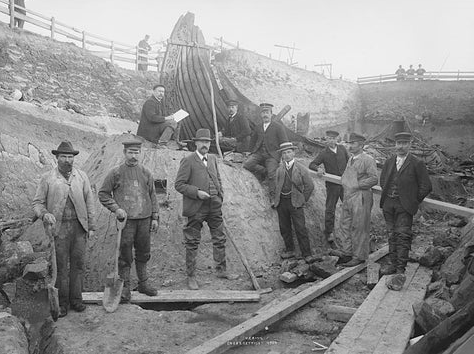
In 1904, a burial mound was excavated near Tønsberg in the county of Vestfold, Norway. Researchers expected to find the remains of a powerful male chieftain. Instead, what they uncovered was one of the most remarkable archaeological finds of the Viking Age — a nearly intact ship burial, complete with a wealth of artifacts and the remains of two women, one presumed to be a high-ranking Norse queen. The Oseberg Ship. Recent research confirmed that the main interred were two women, possibly a queen and her servant or priestess.
I sat with that for a moment.
Man knows little. Written over a thousand years ago, a civilization advanced enough to bury their most powerful women on ships with extraordinary reverence was wise enough to also acknowledge the limits of human knowledge itself. "Man knows little" isn't a dig at men, it's a Norse philosophical acknowledgment that the mysteries of life, death, the cosmos, and the divine are larger than any of us.
It's the Viking equivalent of Socrates saying "I know that I know nothing.” It reads like something a völva would leave behind on purpose… a final, quiet reminder carved into wood for whoever came looking.
This is not mythology. This is archaeology. This is history. These women existed, the seers, the shield maidens, the queens buried with carts and tapestries and horses and the bones of those who served them. They held their communities together, prophesied their futures, and shaped the world around them with a kind of knowing that cannot be coded, automated, or explained away.
The thread from the Skalds to the Völvas to you is not as long as you think.
Your intuition is not a glitch. It is a lineage. 👑
TODAY’S MANTRA
Your story is not a burden. It is a blueprint.
Happy Spring! Stay tuned for updates & Regal announcements coming soon!
Con Mucho Amor,
Tanyette
Smart. Soulful. Aligned.
Reply